
How to Choose a General Contractor in Dallas: A Developer’s Checklist
Knowing how to choose a general contractor in Dallas is one of the most important decisions a multifamily developer can make. The contractor selected will influence every phase of the project, from preconstruction planning and budgeting to scheduling, quality control, and final completion. A qualified contractor helps reduce risk, improve communication, and keep projects aligned with financial and operational goals. The wrong contractor can create delays, increase costs, and complicate relationships with lenders, investors, and project stakeholders.
Developers planning apartment communities frequently partner with experienced multifamily construction professionals to evaluate project feasibility, coordinate design teams, and establish construction strategies before work begins. Selecting the right contractor early creates a stronger foundation for successful project execution while reducing the likelihood of costly surprises throughout construction.
Unlike residential remodeling projects, multifamily developments require contractors who understand large-scale coordination, municipal approvals, procurement planning, subcontractor management, and investor expectations. Every decision made during contractor selection has long-term implications for the project’s financial performance and schedule.
This guide provides a practical checklist that helps developers compare contractors objectively, identify warning signs early, and make informed hiring decisions that support successful multifamily construction throughout the Dallas market.
Reserve at Mayfield project by ELITE Construction
The Reserve at Mayfield is a ground-up construction project in Arlington, TX
TL;DR
Choosing a general contractor involves much more than comparing prices. Developers should evaluate experience, licensing, insurance, project management systems, references, communication practices, financial stability, and bid transparency before awarding a contract. A structured evaluation process reduces project risk and improves long-term outcomes.
Key Takeaways
- Contractor selection directly affects project success.
- Experience with multifamily developments matters.
- Licensing, insurance, and financial stability should always be verified.
- Bid transparency is more valuable than the lowest price.
- References and communication reveal how contractors perform during construction.
- ELITE Construction emphasizes collaboration, planning, and accountability from preconstruction through project completion.

Why Contractor Selection Matters
Multifamily developments involve significant financial investment, multiple stakeholders, and strict construction schedules. Once construction begins, changing contractors becomes extremely difficult and often expensive.
Selecting the right contractor reduces uncertainty by establishing clear expectations before work starts. An experienced contractor contributes valuable insight during planning while coordinating architects, engineers, consultants, subcontractors, and municipal agencies throughout construction.
Developers should view contractor selection as a long-term business decision rather than simply choosing the lowest bidder.
How to Choose a General Contractor in Dallas
Every contractor may present an attractive proposal, but qualifications vary considerably. The following checklist helps developers evaluate firms consistently while focusing on the characteristics that contribute to successful multifamily projects.
1. Evaluate Relevant Multifamily Experience
Experience should always be the first consideration.
Ask contractors questions such as:
- How many multifamily projects have you completed?
- What was the size of those developments?
- Have you completed projects similar to ours?
- What delivery methods have you used?
Apartment construction differs significantly from office buildings, retail centers, or residential remodeling. Contractors familiar with multifamily developments understand building systems, occupancy requirements, amenity construction, and complex scheduling.
Review completed project portfolios rather than relying solely on marketing materials.
2. Verify Licensing, Insurance, and Safety Programs
Before discussing budgets or schedules, verify that each contractor maintains appropriate business credentials.
Developers should request documentation confirming:
- General liability insurance
- Workers’ compensation coverage
- Builder’s risk requirements
- Bonding capacity, when applicable
Texas does not require a statewide general contractor license, but local jurisdictions often have registration or permitting requirements. Developers should verify compliance with the municipality where construction will occur.
The Texas Department of Licensing and Regulation provides information regarding licensing requirements for regulated construction trades and related professions, helping developers better understand regulatory responsibilities before construction begins.
A qualified contractor should willingly provide documentation and answer questions regarding insurance coverage and safety practices.
3. Review Project Management Systems
Strong construction companies rely on structured management systems rather than informal communication.
Ask how the contractor manages:
- Scheduling
- Budget reporting
- Change orders
- Quality control
- Subcontractor coordination
- Owner communication
- Document management
Experienced firms provide consistent reporting throughout construction, allowing ownership teams to monitor progress and make informed decisions.
Developers working alongside experienced multifamily construction teams often benefit from standardized reporting processes that improve transparency from preconstruction through project closeout.
4. Evaluate Communication Practices
Communication problems frequently become construction problems.
During the interview process, evaluate how clearly the contractor explains:
- Scheduling expectations
- Budget assumptions
- Potential risks
- Decision-making processes
- Owner responsibilities
Clear communication before contracts are signed often reflects how the project will be managed after construction begins.
Developers should understand who will serve as the primary point of contact and how frequently project updates will occur.
5. Compare Bids Beyond the Bottom Line
One of the most common mistakes developers make is selecting the lowest proposal without understanding what is included in the price. Construction bids should be evaluated based on scope, assumptions, scheduling, and overall value rather than cost alone.
A comprehensive proposal should clearly identify:
- Scope of work
- General conditions
- Labor costs
- Material allowances
- Subcontractor responsibilities
- Equipment requirements
- Permit responsibilities
- Contingency assumptions
- Schedule milestones
Developers should also identify any exclusions that could become future change orders. A lower bid that omits important project components may ultimately become more expensive than a higher proposal with a complete scope.
Rather than asking, “Which contractor is the least expensive?” developers should ask, “Which contractor provides the greatest value with the lowest overall project risk?”
6. Verify Financial Stability
Financial strength plays an important role in successful project delivery.
Contractors with stable financial resources are generally better positioned to:
- Purchase materials early
- Maintain adequate staffing
- Absorb market fluctuations
- Manage subcontractor payments
- Continue work despite unexpected challenges
Developers should discuss:
- Bonding capacity
- Banking relationships
- Years in business
- Current workload
- Experience managing projects of similar size
Financial stability helps reduce the likelihood of construction interruptions caused by cash flow challenges.
7. Ask for Relevant References
Project references provide valuable insight beyond photographs and marketing materials.
Request references from owners who completed projects similar in:
- Size
- Budget
- Construction type
- Delivery method
- Geographic market
Questions to ask former clients include:
- Was the project completed on schedule?
- Did final costs align with expectations?
- How were unexpected issues handled?
- Was communication consistent throughout construction?
- Would you hire this contractor again?
Patterns across multiple references often provide a more accurate picture than a single positive testimonial.
8. Evaluate Preconstruction Capabilities
Strong contractors contribute value before construction begins.
Ask whether the contractor provides assistance with:
- Budget development
- Constructability reviews
- Value engineering
- Procurement planning
- Schedule development
- Site logistics
- Design coordination
Developers who involve contractors during preconstruction often identify opportunities to improve efficiency while reducing project risk.
9. Understand Their Quality Control Process
Quality should never rely solely on final inspections.
Experienced contractors implement quality management throughout construction using structured review processes.
Developers should ask:
- How is work inspected?
- Who performs quality reviews?
- How are deficiencies documented?
- How are subcontractors held accountable?
- What closeout procedures are followed?
Consistent quality control reduces rework while improving long-term building performance.
10. Discuss Project Closeout Expectations
Construction is not complete when the final trade leaves the site.
Developers should understand how contractors manage:
- Final inspections
- Punch lists
- Warranty documentation
- Owner training
- As-built drawings
- Closeout manuals
A structured closeout process helps ownership transition smoothly into property operations.
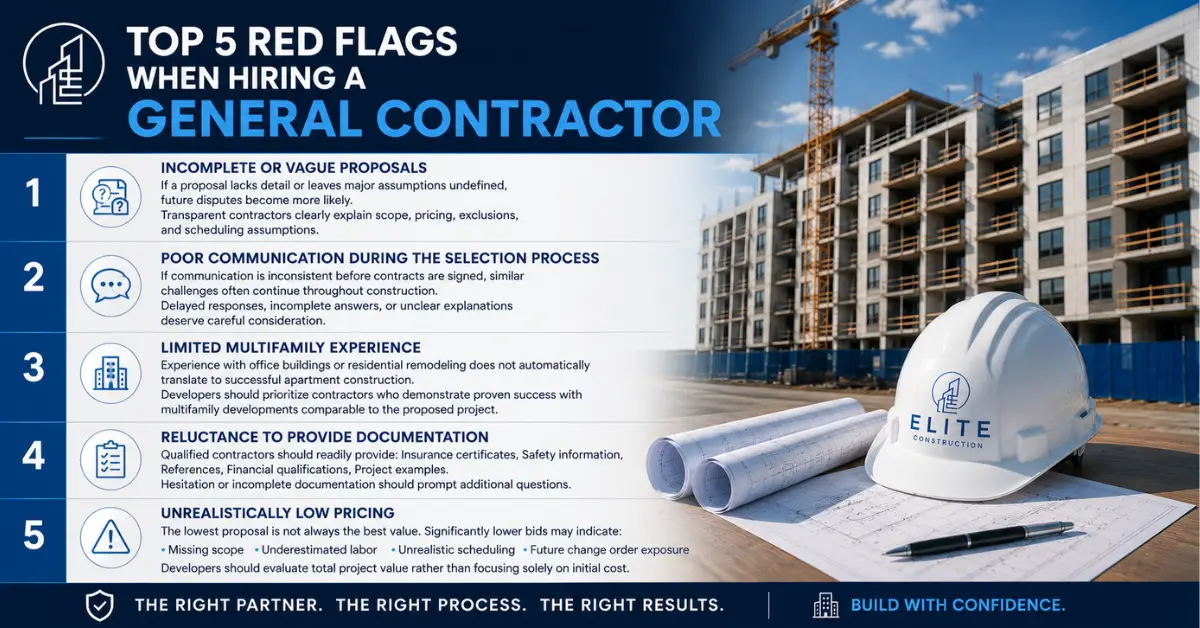
Top 5 Red Flags When Hiring a General Contractor
1. Incomplete or Vague Proposals
If a proposal lacks detail or leaves major assumptions undefined, future disputes become more likely.
Transparent contractors clearly explain scope, pricing, exclusions, and scheduling assumptions.
2. Poor Communication During the Selection Process
If communication is inconsistent before contracts are signed, similar challenges often continue throughout construction.
Delayed responses, incomplete answers, or unclear explanations deserve careful consideration.
3. Limited Multifamily Experience
Experience with office buildings or residential remodeling does not automatically translate to successful apartment construction.
Developers should prioritize contractors who demonstrate proven success with multifamily developments comparable to the proposed project.
4. Reluctance to Provide Documentation
Qualified contractors should readily provide:
- Insurance certificates
- Safety information
- References
- Financial qualifications
- Project examples
Hesitation or incomplete documentation should prompt additional questions.
5. Unrealistically Low Pricing
The lowest proposal is not always the best value.
Significantly lower bids may indicate:
- Missing scope
- Underestimated labor
- Unrealistic scheduling
- Future change order exposure
Developers should evaluate total project value rather than focusing solely on initial cost.
Questions Every Developer Should Ask Before Hiring
Meaningful conversations often reveal more than proposal documents alone.
Consider asking:
- What challenges do you anticipate on this project?
- How do you manage schedule changes?
- What reporting will ownership receive?
- Who will supervise construction daily?
- How are subcontractors selected?
- What technology supports project management?
- How do you control project costs?
- What differentiates your approach from other contractors?
These discussions help developers understand how contractors solve problems rather than simply how they price projects.
Why Developers Partner With ELITE Construction
ELITE Construction believes successful multifamily developments begin long before construction starts. By emphasizing planning, communication, and collaboration, the company helps developers establish realistic budgets, coordinate design efforts, and reduce project risk from the earliest stages of development.
Working closely with architects, engineers, consultants, and ownership teams, ELITE Construction provides support throughout:
- Preconstruction planning
- Budget development
- Scheduling
- Procurement coordination
- Construction management
- Quality control
- Project closeout
This collaborative approach helps developers make informed decisions while maintaining transparency throughout every phase of construction.
The Associated General Contractors of America publishes industry resources and best practices that reinforce the importance of strong project management, safety, and contractor accountability across commercial construction projects. Developers who understand these standards are often better equipped to evaluate prospective construction partners.

Frequently Asked Questions
How do you choose a general contractor in Dallas for a multifamily project?
Developers should evaluate contractors based on multifamily experience, project management capabilities, licensing and insurance, financial stability, communication practices, references, safety performance, and bid transparency. Selecting a contractor should involve a comprehensive review of qualifications rather than simply accepting the lowest proposal.
What should developers look for when comparing contractor bids?
Every proposal should clearly define the scope of work, project schedule, material allowances, exclusions, payment milestones, and contingency assumptions. Comparing bids line by line helps identify missing scope or unrealistic pricing that could lead to future change orders.
Why is multifamily experience important?
Apartment communities require coordination between multiple trades, complex building systems, municipal approvals, and extensive project scheduling. Contractors with multifamily experience understand these challenges and are better prepared to manage them efficiently.
How important are references during contractor selection?
References provide valuable insight into how contractors perform during active construction. Speaking with previous owners allows developers to verify communication, schedule performance, budget management, and overall project satisfaction.
Should developers involve contractors before construction begins?
Yes. Early contractor involvement often improves budgeting, constructability reviews, procurement planning, scheduling, and value engineering. Preconstruction collaboration helps identify challenges before construction starts, reducing both risk and unexpected costs.
Conclusion
Understanding how to choose a general contractor in Dallas requires more than comparing prices or reviewing marketing materials. Developers should evaluate qualifications, communication practices, project management systems, financial stability, references, and relevant multifamily experience before awarding a construction contract.
A structured evaluation process helps reduce project uncertainty while improving budgeting, scheduling, and long-term project performance. Contractors who emphasize collaboration, transparency, and proactive planning often become valuable partners throughout the development lifecycle rather than simply managing construction activities.
For multifamily developments, selecting the right contractor is one of the most important decisions an ownership team will make. Developers who invest time in evaluating experience, verifying credentials, comparing proposals carefully, and involving construction professionals early are better positioned to deliver projects that meet schedule expectations, maintain budget discipline, and achieve long-term investment goals.
ELITE Construction partners with developers throughout every phase of multifamily construction by providing comprehensive planning, disciplined project management, and transparent communication. From preconstruction through project closeout, the company’s collaborative approach helps ownership teams reduce risk while delivering high-quality apartment communities throughout Dallas and beyond.
General Contractor by ELITE Construction
ELITE Construction is a general contractor in Dallas, Texas. Projects include apartment buildings, condominiums, duplexes, townhomes, and more.
About the Author
ELITE Construction is a commercial general contractor specializing in multifamily, hospitality, senior living, and large-scale residential development projects throughout the United States. The company works alongside developers, investors, architects, and ownership teams to deliver projects that prioritize quality, accountability, communication, and long-term value.
Learn more about ELITE Construction and discover the company’s experience, leadership, and project philosophy on the About ELITE Construction page.
Explore more blogs...
Hospitality Renovation: Transforming Hotels and Guest Experiences Across Florida
The hospitality industry is changing faster than ever before. Hotels, resorts, and entertainment properties across Florida are updating their spaces to meet the evolving expectations of travelers. Guests no longer just want a place to stay; they want comfort,...

Apartment Building Construction in Florida: What Developers Need to Know
Florida is one of the fastest-growing states in the country, attracting millions of new residents each year. From retirees seeking sunshine to young professionals drawn to booming cities like Miami and Orlando, the demand for rental housing has never been higher....

Multifamily Construction Schedule: How to Stay on Time and Budget
A multifamily construction schedule organizes the work from preconstruction, design and permitting through sitework, vertical construction, inspections and turnover. A useful schedule also identifies dependencies, long-lead materials, decision deadlines and risks that...