
What Are Preconstruction Services? A Guide for Multifamily Developers
Understanding what preconstruction services are is one of the most important steps multifamily developers can take before beginning a new apartment project. Long before equipment arrives on site or foundations are poured, successful developments are shaped through careful planning, cost analysis, scheduling, risk evaluation, and collaboration between owners, architects, engineers, and contractors. Decisions made during preconstruction often determine whether a project stays on budget, meets its schedule, and achieves its investment objectives.
Developers planning new apartment communities frequently partner with experienced multifamily construction professionals to establish realistic budgets, evaluate site conditions, coordinate design efforts, and identify potential challenges before construction begins. This early collaboration creates opportunities to improve efficiency, reduce costly changes, and strengthen communication across the entire project team.
At ELITE Construction, preconstruction is viewed as far more than an estimating exercise. It is a strategic planning process that helps developers make informed decisions throughout every stage of a multifamily project. By addressing constructability, procurement, scheduling, and budgeting before breaking ground, owners gain greater confidence that their investment is positioned for long-term success.
This guide explains what preconstruction services include, why they matter for multifamily development, and how they help reduce risk while improving project outcomes.
Reserve at Mayfield project by ELITE Construction
The Reserve at Mayfield is a ground-up construction project in Arlington, TX
TL;DR
Preconstruction services provide the planning, budgeting, scheduling, design coordination, and risk management needed before construction begins. For multifamily developers, investing in preconstruction helps improve cost certainty, identify project challenges early, strengthen collaboration, and create a smoother path from concept to completion.
Key Takeaways
- Preconstruction services begin before physical construction starts.
- Early planning improves budgeting accuracy and schedule reliability.
- Design coordination reduces costly field changes.
- Risk identification helps avoid delays and unexpected expenses.
- Procurement planning supports material availability and cost control.
- ELITE Construction uses preconstruction to help developers make informed decisions before construction begins.
Why Preconstruction Services Matter for Multifamily Development
Multifamily developments involve far more complexity than many other commercial construction projects. Developers must coordinate land acquisition, financing, design teams, consultants, permitting agencies, utility providers, subcontractors, and material suppliers while balancing budgets and schedules. Without a structured planning process, even minor issues can create significant delays or increase project costs.
Preconstruction services establish the foundation for a successful development by bringing key stakeholders together before construction begins. Rather than reacting to problems in the field, developers have the opportunity to identify risks, evaluate alternatives, and make informed decisions while changes are still relatively inexpensive.
Owners who invest in comprehensive multifamily planning services often experience better cost control, improved communication, and fewer unexpected disruptions during construction.
Improving Budget Accuracy Before Construction Begins
One of the primary objectives of preconstruction is developing a realistic project budget.
Early cost estimating evaluates every major component of the development, including:
- Site preparation
- Foundations and structural systems
- Building envelope
- Mechanical, electrical, and plumbing systems
- Interior finishes
- Landscaping and site amenities
- Contingency planning
Instead of relying on broad assumptions, developers receive detailed cost information that supports financing decisions and investment planning.
As designs evolve, budget estimates are refined to reflect current market conditions, helping ownership understand how design choices influence overall project costs.
Identifying Risks Before They Become Expensive Problems
Every construction project carries risk, but many risks can be reduced through careful planning.
During preconstruction, project teams evaluate factors such as:
- Site access and logistics
- Existing utilities
- Soil conditions
- Municipal approval requirements
- Environmental concerns
- Material availability
- Labor market conditions
Addressing these issues before construction begins often prevents delays that can affect schedules and budgets.
For example, discovering utility conflicts during excavation can delay multiple trades and increase project costs. Identifying the same issue during preconstruction allows teams to adjust designs or coordinate relocations before work begins.
Strengthening Design Coordination
Architects create the project vision, but successful construction requires that designs also be practical to build.
Preconstruction allows contractors to collaborate with architects and engineers throughout the design process, providing constructability feedback before drawings are finalized.
This collaboration helps identify:
- Coordination conflicts between building systems
- Opportunities to simplify construction
- Material alternatives
- Sequencing considerations
- Long lead procurement items
Early design coordination often reduces field modifications, minimizes change orders, and supports a more efficient construction process.
Supporting Better Financial Decisions
Developers rely on accurate information when evaluating project feasibility.
Preconstruction provides valuable insight into:
- Expected construction costs
- Procurement timelines
- Market pricing trends
- Potential schedule risks
- Financing considerations
Many developers also review construction spending data published by the U.S. Census Bureau to understand broader market activity while evaluating project timing and investment opportunities.
This financial visibility allows ownership teams to make informed decisions before committing significant capital.
Improving Collaboration Across the Entire Project Team
Multifamily construction requires continuous coordination between multiple disciplines.
Preconstruction brings together:
- Developers
- Architects
- Engineers
- General contractors
- Consultants
- Municipal agencies
- Key subcontractors
Establishing communication early helps align project goals, clarify responsibilities, and create a more collaborative working environment throughout construction.
For developers partnering with an experienced multifamily construction team, this collaborative approach often leads to smoother execution, improved accountability, and stronger project outcomes from planning through completion.
What Are Preconstruction Services?
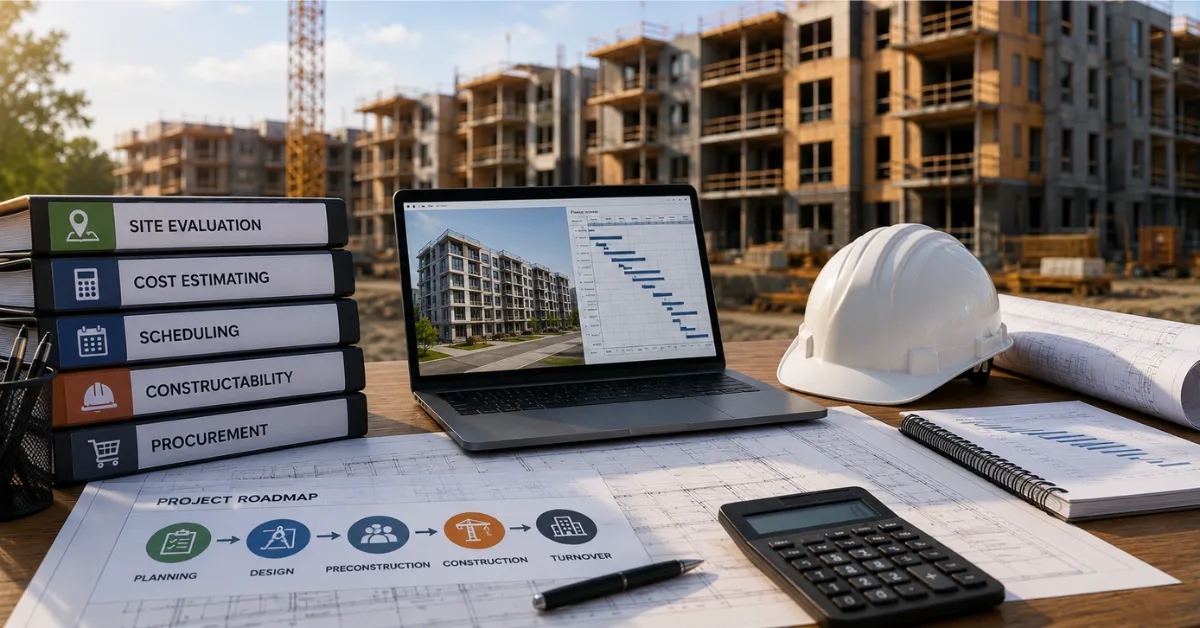
Preconstruction services encompass the planning, coordination, and analysis performed before physical construction begins. Rather than focusing solely on cost estimating, modern preconstruction establishes a roadmap for the entire project by aligning budgets, schedules, design decisions, procurement strategies, and construction logistics.
For multifamily developers, preconstruction creates an opportunity to make informed decisions before significant financial commitments are made. Adjustments that are relatively inexpensive during planning can become costly once construction is underway.
A comprehensive preconstruction process typically includes several interconnected services that work together to improve project predictability and reduce risk.
Site Evaluation and Due Diligence
Every successful multifamily development begins with understanding the property itself.
Site evaluation includes reviewing:
- Existing utilities
- Topography
- Drainage conditions
- Soil reports
- Environmental considerations
- Easements
- Access points
- Municipal development requirements
These evaluations help identify potential constraints before they affect construction schedules or budgets.
For example, discovering unsuitable soil conditions before design completion allows engineers to develop foundation solutions early rather than making expensive adjustments during construction.
Cost Estimating and Budget Development
Budget development evolves throughout preconstruction as more project information becomes available.
Early estimates provide developers with a high-level understanding of anticipated construction costs. As design progresses, estimates become increasingly detailed, allowing ownership teams to evaluate design decisions against available funding.
Budget development commonly includes:
- Hard construction costs
- Soft costs
- General conditions
- Permit and inspection fees
- Site development
- Contingency planning
- Escalation allowances
Accurate estimating provides lenders and investors with greater confidence while helping developers avoid funding gaps later in the project.
Scheduling and Project Phasing
Construction schedules are more than completion dates. They establish how work will progress from groundbreaking through final turnover.
During preconstruction, scheduling activities often include:
- Milestone development
- Procurement timelines
- Long lead material planning
- Permit coordination
- Utility scheduling
- Inspection sequencing
Developing realistic schedules early helps identify potential bottlenecks before they delay construction.
Constructability Reviews
One of the most valuable components of preconstruction is the constructability review.
Rather than waiting until construction begins, contractors evaluate drawings to determine whether the project can be built efficiently using practical construction methods.
Constructability reviews often identify:
- Conflicts between building systems
- Inefficient sequencing
- Material substitutions
- Opportunities for value engineering
- Accessibility concerns
- Coordination issues between disciplines
Resolving these issues during design typically costs far less than correcting them after construction begins.
Procurement Planning
Material procurement has become increasingly important as lead times continue to fluctuate across the construction industry.
Preconstruction teams evaluate:
- Long lead equipment
- Supplier availability
- Material pricing
- Alternative products
- Procurement sequencing
Early procurement planning helps reduce schedule uncertainty while protecting budgets from market volatility.
According to the Associated Builders and Contractors Construction Backlog Indicator, labor availability and material procurement continue to influence commercial construction schedules across the country. Developers who account for these factors during preconstruction are often better prepared to maintain project momentum.
Permitting and Regulatory Coordination
Multifamily developments frequently require approvals from multiple agencies before construction can begin.
Preconstruction teams help coordinate:
- Zoning compliance
- Building permits
- Utility approvals
- Stormwater management
- Fire department reviews
- Accessibility requirements
Understanding permitting timelines early allows developers to establish more accurate project schedules and avoid unnecessary delays.
By integrating budgeting, scheduling, design coordination, procurement, and permitting into a single planning process, preconstruction services provide developers with the information needed to make confident decisions before construction begins. This proactive approach reduces uncertainty while creating a stronger foundation for successful multifamily developments.
Benefits of Preconstruction Services for Multifamily Developers
Preconstruction provides developers with more than an organized planning process. It establishes a framework for making informed decisions that improve project performance from concept through completion. By investing time before construction begins, owners often reduce uncertainty, improve collaboration, and strengthen financial outcomes.
Greater Cost Certainty
Construction budgets are most effective when they evolve alongside the project design.
Rather than waiting until bid day to discover pricing concerns, preconstruction allows developers to receive updated cost information throughout the planning process. As architectural drawings become more detailed, estimates are refined to reflect current labor rates, material pricing, and project scope.
This ongoing cost analysis helps developers:
- Compare design options
- Prioritize project features
- Allocate contingency funds appropriately
- Make informed investment decisions
- Reduce the likelihood of significant budget overruns
When project costs are understood early, ownership teams have greater flexibility to adjust the design before expensive changes become necessary during construction.
Better Schedule Predictability
Construction schedules are affected by far more than field productivity.
Material lead times, permitting approvals, utility coordination, labor availability, and weather conditions all influence project duration. Preconstruction evaluates these factors before work begins, allowing project teams to develop realistic schedules that reflect actual project conditions.
Effective scheduling also supports:
- Financing milestones
- Investor reporting
- Leasing strategies
- Occupancy planning
- Procurement coordination
Developers who establish achievable schedules early often experience fewer disruptions throughout construction.
Improved Communication Between Stakeholders
Multifamily developments involve numerous participants working toward a common objective.
These often include:
- Owners
- Development managers
- Architects
- Civil engineers
- Structural engineers
- MEP consultants
- Municipal agencies
- General contractors
- Specialty subcontractors
Without a structured communication process, misunderstandings can lead to conflicting expectations and delayed decisions.
Preconstruction establishes regular collaboration among these groups, ensuring that major decisions are discussed before construction begins. This transparency helps reduce confusion while improving accountability throughout the project.
Fewer Change Orders During Construction
Change orders are one of the most common causes of construction budget increases.
Many change orders occur because issues were not identified during design or because project requirements changed after construction started.
Preconstruction reduces this risk by thoroughly reviewing:
- Construction documents
- Building systems
- Site logistics
- Material selections
- Project sequencing
- Budget alignment
Although no project eliminates every change order, early coordination often minimizes unnecessary revisions and helps maintain financial stability.
Stronger Risk Management
Every development project involves uncertainty.
Preconstruction provides an opportunity to identify potential risks before they become active construction issues.
Risk management may include evaluating:
- Escalating material costs
- Supply chain disruptions
- Utility conflicts
- Weather impacts
- Permitting timelines
- Labor shortages
- Site constraints
Developers who understand these risks early are better prepared to develop contingency plans that protect both budgets and schedules.
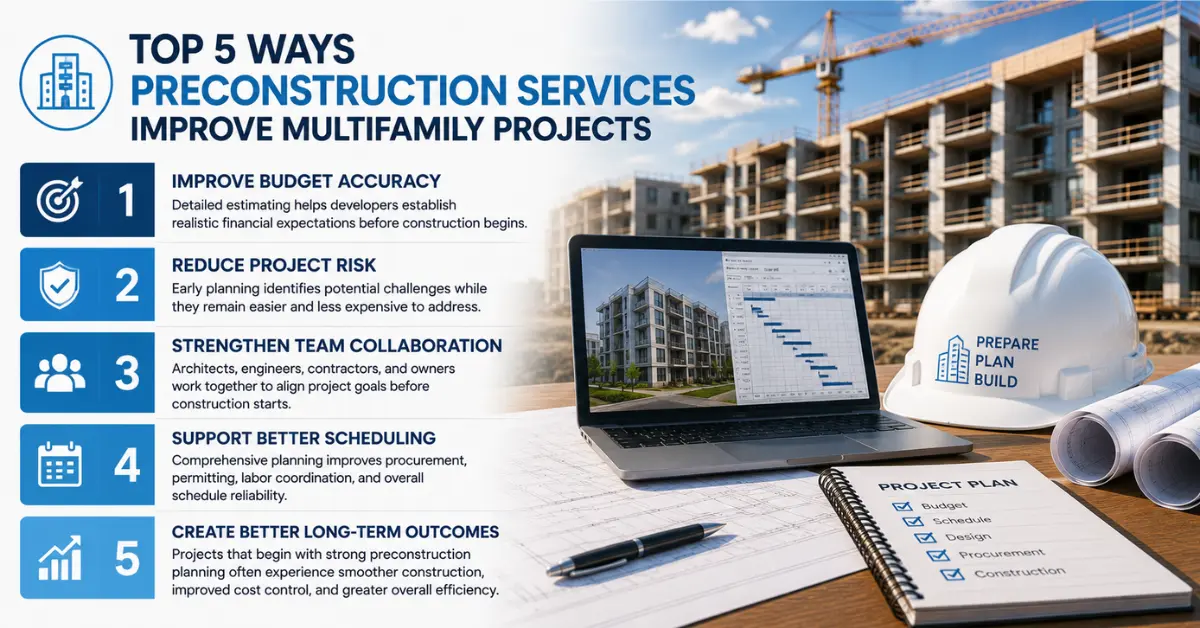
Top 5 Ways Preconstruction Services Improve Multifamily Projects
1. Improve Budget Accuracy
Detailed estimating helps developers establish realistic financial expectations before construction begins.
2. Reduce Project Risk
Early planning identifies potential challenges while they remain easier and less expensive to address.
3. Strengthen Team Collaboration
Architects, engineers, contractors, and owners work together to align project goals before construction starts.
4. Support Better Scheduling
Comprehensive planning improves procurement, permitting, labor coordination, and overall schedule reliability.
5. Create Better Long-Term Outcomes
Projects that begin with strong preconstruction planning often experience smoother construction, improved cost control, and greater overall efficiency.
Common Mistakes Developers Make Without Preconstruction
Some developers view preconstruction as an optional expense rather than an investment. In reality, skipping this phase often increases project uncertainty.
Common mistakes include:
Relying on Preliminary Budgets
Conceptual estimates are useful early in the development process, but they should not serve as the sole basis for financing decisions. Without detailed estimating, actual construction costs may differ significantly from early assumptions.
Delaying Contractor Involvement
Bringing a contractor into the project after design completion limits opportunities for constructability input, procurement planning, and value engineering.
Early collaboration frequently identifies opportunities that improve both cost efficiency and schedule performance.
Underestimating Procurement Timelines
Many construction materials require extended manufacturing and delivery periods.
Failing to plan for long lead items can delay critical project milestones even when field work progresses as scheduled.
Overlooking Municipal Requirements
Each jurisdiction maintains its own permitting and review processes.
Developers who understand local requirements during preconstruction are often able to avoid unnecessary delays later in the project.
Focusing Only on Initial Construction Costs
The lowest upfront cost does not always produce the greatest long-term value.
Preconstruction encourages developers to evaluate durability, maintenance requirements, operating expenses, and lifecycle costs alongside initial construction pricing. This broader perspective often leads to stronger investment performance over the life of the property.
How ELITE Construction Approaches Preconstruction
Successful multifamily developments begin with informed decision-making. At ELITE Construction, preconstruction is a collaborative process that helps developers evaluate opportunities, reduce uncertainty, and establish a clear path toward construction. Rather than treating preconstruction as a single milestone, it is integrated throughout the early stages of project development to improve communication, budgeting, scheduling, and execution.
By working closely with owners, architects, engineers, and consultants, ELITE Construction helps identify potential challenges before they affect construction activities. This proactive approach allows project teams to make adjustments while flexibility remains high and costs remain more manageable.
Collaborative Planning From Day One
Every multifamily project has unique goals, constraints, and investment objectives.
Preconstruction begins by developing a clear understanding of:
- Project scope
- Development schedule
- Budget expectations
- Site characteristics
- Long-term operational goals
Establishing these priorities early helps align all stakeholders around common objectives before design progresses too far.
Budget Reviews Throughout Design
Construction costs evolve as project details become more refined.
Rather than relying on a single estimate, ELITE Construction continually reviews budgets throughout design development, helping owners understand how design decisions influence overall project costs.
This ongoing review process supports:
- Better financial forecasting
- Earlier identification of cost concerns
- More informed design decisions
- Greater confidence for lenders and investors
Developers gain a clearer understanding of project costs before construction contracts are finalized.
Constructability and Value Engineering
As design documents develop, ELITE Construction performs constructability reviews to evaluate how plans will perform in the field.
These reviews focus on:
- Construction sequencing
- Coordination between trades
- Material availability
- Installation efficiency
- Long-term building performance
When opportunities for improvement are identified, value engineering recommendations are provided without compromising quality, safety, or project objectives.
The goal is not simply to reduce costs but to maximize value by balancing performance, durability, schedule, and budget.
Procurement and Schedule Coordination
Long lead materials can significantly affect multifamily construction schedules.
During preconstruction, procurement planning identifies equipment and materials that require early ordering, including:
- Electrical switchgear
- HVAC equipment
- Elevators
- Roofing systems
- Specialty finishes
- Building envelope components
Coordinating procurement with the construction schedule helps reduce delays and supports more predictable project delivery.

FAQs
What are preconstruction services?
Preconstruction services include the planning, budgeting, scheduling, design coordination, procurement planning, constructability reviews, and risk evaluation completed before physical construction begins. These services help developers make informed decisions and establish a strong foundation for successful projects.
Why are preconstruction services important for multifamily construction?
Multifamily developments involve numerous stakeholders, complex building systems, and significant financial investment. Preconstruction improves coordination, identifies risks early, strengthens budgeting accuracy, and helps reduce delays during construction.
When should developers begin preconstruction services?
Preconstruction should begin as early as possible, ideally during site evaluation or conceptual design. Early collaboration allows developers to evaluate budgets, schedules, and project feasibility before major commitments are made.
How do preconstruction services reduce project costs?
Preconstruction reduces costs by identifying potential issues before construction begins, improving cost estimating, supporting value engineering, coordinating procurement, and minimizing change orders that could affect budgets later in the project.
Are preconstruction services only for large apartment developments?
No. While preconstruction is especially valuable for large multifamily communities, developers of projects of many sizes benefit from improved planning, stronger communication, and more accurate budgeting before construction begins.
Multifamily Renovation by ELITE Construction
Conclusion
Understanding what preconstruction services are is essential for developers who want to deliver successful multifamily projects with greater confidence and fewer surprises. Effective preconstruction goes beyond preparing an estimate. It establishes the financial, operational, and construction strategy that guides every phase of the project.
By investing in comprehensive planning, design coordination, constructability reviews, procurement planning, and risk management, developers can improve budget accuracy, strengthen scheduling, and reduce costly changes during construction. These early decisions frequently have a lasting impact on project performance, investor confidence, and long-term asset value.
Developers who partner with experienced multifamily construction professionals gain valuable insight throughout the planning process while positioning their projects for smoother execution and stronger financial outcomes. ELITE Construction works collaboratively with owners, architects, engineers, and consultants to help transform project concepts into successful multifamily communities through thoughtful planning and disciplined project management.
About the Author
ELITE Construction is a commercial general contractor specializing in multifamily, hospitality, senior living, and large-scale development projects across the United States. The company partners with developers, investors, architects, and ownership teams to deliver projects that emphasize quality, communication, efficiency, and long-term value.
Learn more about ELITE Construction and explore the company’s experience, leadership, and approach on the About ELITE Construction page.
Explore more blogs...

The 3 Most Common Types of Construction Contracts
You've finally made the decision: you’re ready to turn your property into an investment. After exploring residential, commercial, and industrial options, you’ve found the one that feels right. Eager to start this journey, you’re ready to just sign a contract and get...

Essential Tips for Designing Comfortable Senior Living Environments
As you get older, your tastes and requirements change. At twenty, you might find yourself liking the flavor of tomatoes. By forty, you may start to feel that your fashion choices no longer reflect who you are. Then, at the age of sixty, while you embrace the...

What Does a Commercial General Contractor Do and What to Look for in a Contractor
A commercial general contractor manages the construction of a commercial or multifamily project from preconstruction through closeout. The GC coordinates the schedule, budget, subcontractors, permits, site safety, quality control, inspections and final turnover so the...